
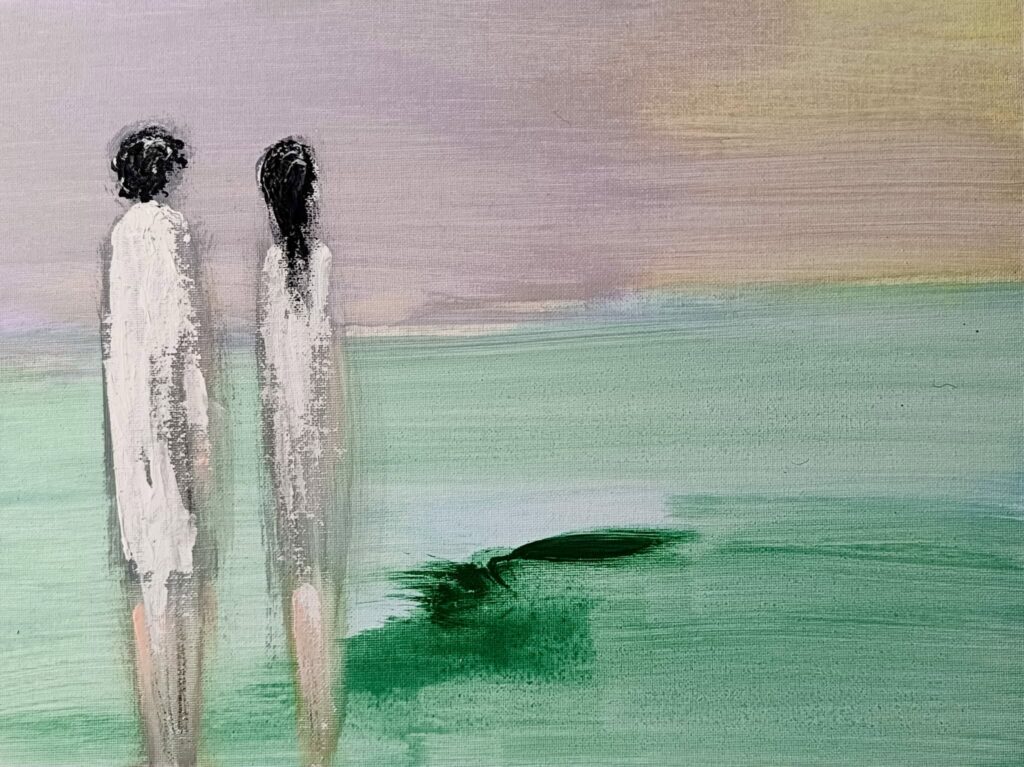
„People come from people — this is how God willed it”, Witold Urbanowicz, Paryż 2026 rok.
About the Litany of the Most Sacred Mind of Our Lord Jesus Christ
The following questions help explain the origins, meaning, language and spiritual purpose of the Litany. They also provide insight into the ideas that guided its composition and into the message expressed through the Litania Christi project.
Why has this type of Litany appeared in the Church only in the 21st century?
This question invites reflection on the plans of Divine Providence itself, which, as the Catechism of the Catholic Church teaches (cf. nos. 306 and 323), “also works through the actions of creatures.” For God “allows human beings to cooperate freely with His designs.”
Perhaps the Holy Spirit wished to inspire this prayer text in response to the new challenges that we may have to face in the time ahead, including the danger of manipulating human thought in the age of so-called artificial intelligence, also in the sphere of religious life.
Were any new invocations added to the Litany after its original version was composed?
No. Apart from corrections to punctuation, spelling and style, no one has changed or added anything to the Litany.
Is the Litany of the Most Sacred Mind of Our Lord Jesus Christ intended to be better than earlier litanies?
Absolutely not. We should not think of it in those terms. No prayer “competes” in some kind of popularity ranking. Such an approach is also mistaken because all litanies — to the Sacred Heart of Jesus, the Precious Blood of Christ, or His Holy Name — refer to the same Person, and Jesus is, of course, indivisible.
It is better to understand the various litanies devoted to Our Lord Jesus Christ as complementing one another, each highlighting a different aspect of the same mystery of Christ.
Why are the website and the application promoting the Litany of the Most Sacred Mind of Our Lord Jesus Christ called LitaniaChristi.org?
The main reason was to avoid using the letter “ś” in an international context. Another aim was to find a name that would not be too long, would be easy to remember, would sound appropriate from a religious point of view, and would not already be in use online.
Was the logo of the Litany created at the same time as the Litany itself?
No. The logo was designed only after the Litany had received the Church’s imprimatur.
Why do the individual invocations use a Latin-style word order, with the verb usually placed at the end of the sentence?
This word order was adopted solely because of the particular rhythm of reciting the prayer and in order to give it a more poetic and solemn character. Apart from these considerations, there were no other reasons for using this particular grammatical construction.
Would it not be better to use the singular response “transform me” instead of the repeated invocation “transform us”?
Probably not. Within the religious community that we help to build together, it is worth maturing in our prayer life by developing a sense of responsibility for one another, rather than thinking only of ourselves.
We might note that the same suggestion could be addressed to Jesus Himself by asking why He taught us to pray “Our Father” rather than “My Father.”